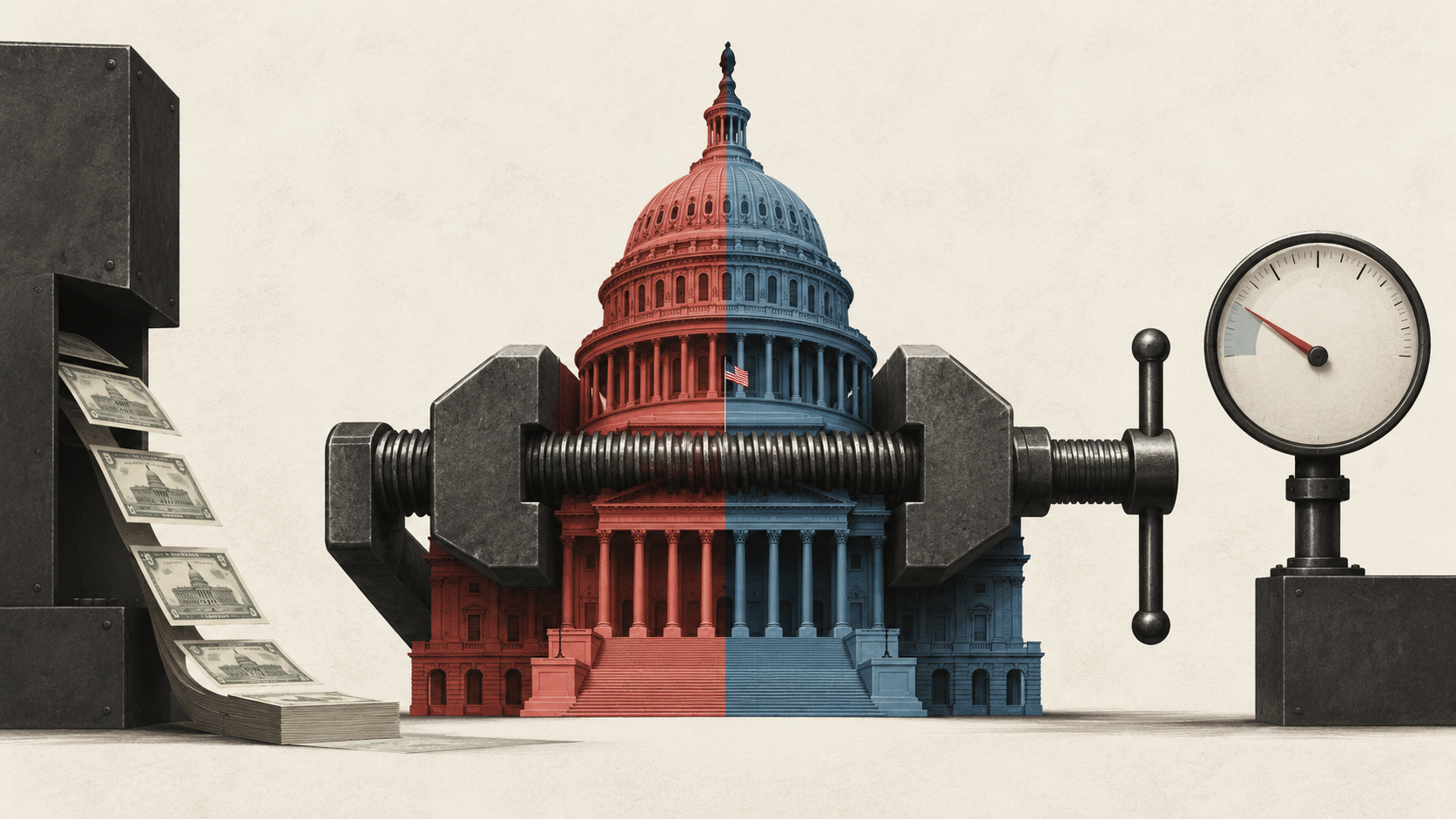
Powell Sweating Yet? Tariffs, Layoffs and Sticky Inflation

Powell Sweating Yet? Tariffs, Layoffs and Sticky Inflation
What You Missed
The economy is flashing mixed signals. Consumer confidence tumbled to 98.3 as concerns over the labor market deepened. Inflation remains stubborn, with core PCE at 2.6% YoY, while consumer spending dropped sharply in nearly four years (0.5%). Jobless claims spiked to 242k, a sign that layoffs – especially from federal workforce cuts – are mounting. Trump’s March 4 tariffs – 25% on Canada and Mexico, 10% on China – kick in tomorrow. Markets are unsure whether to panic or just pretend it’s all a bluff. Either way, buckle up.
Markets seized on the new, negative tone implied by the data, pricing 84 basis points of Fed rate cuts this year, up from 67 basis points just a week ago.
The billion-dollar question now: Has the swift fall in Treasury yields gone too far, too fast? The yield drop has been fast but not furious – no wild overshoot here. Data addressing economic growth kicked off the year a little wobbly, and the Fed policy outlook now feels more like a two-way street than the one-way optimism fest markets priced in earlier. In the short run, the bigger risk is a downturn surprise, while any yield rebound is basically a waiting game – just add time and a sprinkle of good news.
Rates Rundown: Yields Nosedive on Broadening Signals of Uncertainty
Looking for current market rates and historical interest rate data? Check out our Interest Rate Dashboard.
The front end of the yield curve saw a sharp rally (prices up = yields lower), reflecting rising market bets on aggressive Fed cuts later this year. Here’s why:
- Labor market softening – Rising jobless claims and weaker hiring are red flags for growth.
- Fed pivot expectations rising – The bond market is increasingly convinced the Fed will cut rates at least twice this year as tighter fiscal policy bites.
- Inflation is still a problem – Core PCE, the Fed’s favorite inflation gauge, rose at a slower pace, but it’s not cooling fast enough to usher in Fed rate cuts. The Fed is watching services inflation closely, which ticked up in January.
All told, financial markets are shifting toward a softening economy narrative, betting that rate cuts are coming sooner than expected. The fly in the Merlot? The Fed isn’t quite there yet—service inflation remains a problem—but rising layoffs could push the Fed toward a faster pivot. But if inflation comes roaring back – thanks, tariffs – expect this to reverse faster than a politician walking back a campaign promise.
- 10-Year Treasury Yield: Fell 19 bps to 4.21% → Why It Dropped
The bond market is reacting to weakening growth indicators, with the Atlanta Fed’s GDPNow estimate tanking to -1.5% for Q1 and real consumer spending falling 0.5% in January. As fears of a retreating US consumer rise, traders have now upped their bets on two 0.25% Fed rate cuts in 2025, pricing a 69% probability of a June cut and a 61% probability of the same in This new dynamic is pushing Treasury yields lower across the curve. - 2-Year Treasury Yield: Fell 18 bps to 3.99% → The Signal for Short-Term Rates
The step down in the 2-year Treasury yield implies that markets believe the Fed will soon shift toward rate cuts. - 1-month CME Term SOFR: Mostly unchanged at 4.32%
Sentiment Bad, Hard Data Good: What’s the Real Story?
The economy is increasingly delivering mixed signals, making the Fed’s job about as easy as explaining tax policy to a toddler. Hard data – like employment and income – still looks solid. Personal incomes rose in January, meaning people still have money to spend, and will continue to do so – albeit at a slower pace – as long as the income growth (0.9%, month over month) outpaces the monthly inflation date (0.5%).
But soft data, like consumer confidence, is tanking. The Conference Board’s consumer confidence index fell to 98.3, its steepest drop since 2021. Historically, when people feel bad about the economy, they start acting like it’s bad – which eventually makes it bad – a self-fulfilling prophecy. Elsewhere, goods demand cratered (-1.2%), especially for big-ticket items, which signals a consumer slowdown. Combine all that with the fact that the US consumer is the driving force behind 75% of all economic activity, and you’ll understand the reason for concern.
What This Means for the Fed
- If hard data (employment, GDP) stays strong, the Fed may delay rate cuts.
- If soft data (confidence, sentiment) keeps falling, the Fed may cut rates sooner to keep things from spiraling.
Key Interest Rate Trends
- Consumer spending is cooling. January’s 0.5% drop in real spending is the worst since 2021. Big-ticket items like cars, electronics, and appliances saw the steepest declines, suggesting households are starting to tighten their wallets.
- Layoffs are creeping higher. Jobless claims jumped to 242k, largely driven by federal workforce reductions. The Fed may be forced into more aggressive rate cuts if hiring slows further.
- The federal workforce is a wildcard. Total US employment sits at 160 million, but 3 million federal employees and 6 million federal contractors are now eyeing job security concerns. If employment uncertainty keeps rising, expect a broader pullback in consumer spending – especially in discretionary sectors like autos, travel, and household goods.
- Tariffs could fuel inflation. New 25% tariffs on Canada and Mexico and an additional 10% tariff on China take effect tomorrow. If these costs feed into higher goods prices, the Fed may be forced to hold rates higher for longer.
What to Watch This Week: Weak Data to Perpetuate Slowdown Narrative
Monday, March 3 – ISM Manufacturing (Consensus: 50.5, Prior 50.9, Our estimate 50.5)
Manufacturing data for February will likely show factories increasing production, but at a slower pace, while showing that manufacturiers continue to pass along higher inout costs on to consumers. If confirmed, such a dynamic makes it tough for the Fed to cut rates anytime soon.
Wednesday, March 5 – ISM Services Index (Consensus: 52.5, Prior: 53.4, Our estimate 53)
The services sector has held up better than manufacturing, but a sharper decline toward 50.0 or below would signal contraction, adding to concerns that economic momentum is fading. Markets will be watching for any signs of slower price growth in services, which could ease inflation pressures, giving the Fed more reasons to cut.
Wednesday, March 5 – Fed Beige Book Release
This report provides qualitative insights into business sentiment, labor market conditions, and pricing trends. Key areas to watch:
1. Signs of softening wage growth → Would support the case for rate cuts.
2. Consumer demand commentary → Any signs of further spending pullback would be a red flag for growth.
3. Impact of new tariffs → Businesses may begin reporting cost pass-through effects
Friday, March 7 – Nonfarm Payrolls (Consensus: +155k, Our Estimate: +100k)
The labor market is slowing, but how much?
- A print below 100k would cement rate cut expectations and push bond yields lower.
- A strong report above 150k would delay Fed action, keeping rates elevated for longer.
Also in focus: The unemployment rate (Consensus: 4.1%, Prior: 4.0%) and average hourly earnings (Consensus: +0.2% MoM, Prior: +0.6% MoM). A cooling wage number would reassure markets that inflation is still on track to decline.
Outside of economic data, investors seeking relief from nonstop geopolitical developments won’t find it this week. Key events, including ongoing tensions over the war in Ukraine, Trump’s State of the Union address, the implementation of U.S. tariffs, and China’s National People’s Congress, are set to dominate the headlines. Market jitters are becoming evident, with increased bets against the dollar, underperformance in US stocks and a likely retracement in Treasury yields.
Is Stagflation a Real Risk?
Stagflation—a toxic mix of stagnant economic growth, rising unemployment, and persistent inflation—is typically rare but is becoming a growing concern. Right now, the ingredients are falling into place:
- Slowing Growth – Consumer spending is weakening, and layoffs are creeping higher.
- Sticky Inflation – Services inflation remains elevated, and tariffs could push goods prices higher.
- Fed in a Bind – The central bank may be forced to choose between fighting inflation or supporting growth.
If stagflation takes hold, expect Treasury yields to remain volatile as investors hedge against both recession risks and sticky inflation. The Fed would face a tough policy trade-off, potentially keeping rates higher for longer despite economic weakness.
Our Longer-Term Outlook: Where Rates Are Headed Next
Markets are currently pricing in 0.85% of Fed rate cuts in 2025, well beyond our 0.50% forecast. However, inflation remains the wildcard. If layoffs accelerate and consumer spending slows further, the Fed may cut rates sooner and more aggressively than we expect. On the flip side, if tariffs drive up prices, policymakers may hold off on cutting rates entirely.
- 2-Year Treasury Yield Forecast: We expect the 2-year yield to trade between 3.75% and 4.25% in the coming weeks as rate-cut expectations solidify. If the Fed signals a willingness to move quickly, we could see the 2-year fall to 3.50% by Q3 2025.
- 10-Year Treasury Yield Forecast: The 10-year yield broke below our 4.25%-4.75% forecasted range last week, falling to 4.21%. Looking ahead, it’s likely to hover between 4.00% and 4.50%, reflecting a balance between slowing growth and still-elevated inflation risks. If economic data weakens consistently, expect the 10-year to drop toward 3.75%-4.00% by the end of Q2.
- Federal Reserve Policy Outlook: We still expect the Fed to cut twice at most this year, cutting 0.25% at some point mid-year at the soonest, followed by another 0.25% cut in the fall, bringing the Fed funds rate to 4.00%-4.25% by year-end. If job losses increase, the Fed could accelerate its timeline, possibly cutting before June.
Bottom line: It’s Too Soon for Investors to Worry About a Recession
While we remain bullish on the broader economic outlook, we’re watching the data closely for signs of a more significant shift in the business cycle.
Another sharp drop in Treasury yields isn’t warranted just yet, as it remains too early to determine whether the US is facing an imminent slowdown in growth. While signs of a deceleration are emerging, a slowdown is not the same as a recession. The unpredictable nature of recessions makes it difficult to forecast one more than a few months in advance, and this time around is no different.
Last month’s weaker flash purchasing manager indices may have been an early warning that tariff uncertainty and DOGE are starting to weigh on sentiment. However, a single month’s data isn’t enough to confirm a looming recession – it will take sustained weakness to make that call with confidence.
Adding to the cautious mood and a more bullish bond market (lower yields, higher prices) was the Atlanta Fed’s latest GDP nowcast, discussed previously, which plunged to -1.5% for the current quarter from a previous estimate of 2.3%. However, this decline was probably driven by volatility in net trade, particularly a surge in gold imports, which has little to do with underlying US economic growth. A squeeze in the physical gold market, driven by years of central bank hoarding, has prompted an outflow of metal from Europe to the US, making this more of a market dynamic than an economic warning sign.
Recessions represent fundamental shifts in economic regimes, occurring abruptly rather than in a smooth transition. While risks are rising, there isn’t yet enough evidence to suggest the economy is on the verge of such a shift. The recent decline in yields has been justified so far, but from a domestic economic standpoint, there’s little reason to expect another significant drop at this stage.
Treasury yields will remain volatile, offering opportunities for hedging and strategic rate positioning in the months ahead.
Need a customized rate strategy? Contact Derivative Logic for expert guidance.
Stay Defensive on Rate Risk
The rate outlook remains murky. Inflation isn’t fading fast enough, and while weak retail sales sparked a retreat in Treasury yields, the Fed remains cautious.
Key Strategies Smart Borrowers are Executing Now:
- Prepare for a long Fed pause – The market is still adjusting to the reality that cuts won’t come quickly, while the 10-year Treasury yield looks to be stuck on a range for a while. Pricing future deals with this in mind is critical.
- Reconsider interest rate caps – SOFR and rate volatility remain elevated, increasing the cost of rate caps. Locking in costs now for that upcoming rate cap extension or replacement could be wise.
- Consider interest rate Corridors – Are you staring down the barrel of having to replace a rate cap with an expensive, in-the-money strike? An interest rate corridor can be a way to take some of the sting off that high cost. Curious? Reach out to us to find out if a Corridor would work for your specific situation.
- Consider forward-starting swaps – The SOFR forward curve is still inverted – barely – and forward-starting interest rate swaps may allow some borrowers to lock in a lower fixed rate in some situations.
Until next time—stay smart, stay hedged.
The content of this newsletter is for informational purposes only and should not be considered investment advice—or a sign that we have a crystal ball. We’re here to share insights and strategies, but it’s up to you to decide whether they align with your portfolio, risk tolerance, or even your mood today. Take the time to think things through before making any major financial decisions. And remember, past performance is like last year’s vacation photos—interesting to review but not a guarantee of what’s to come!